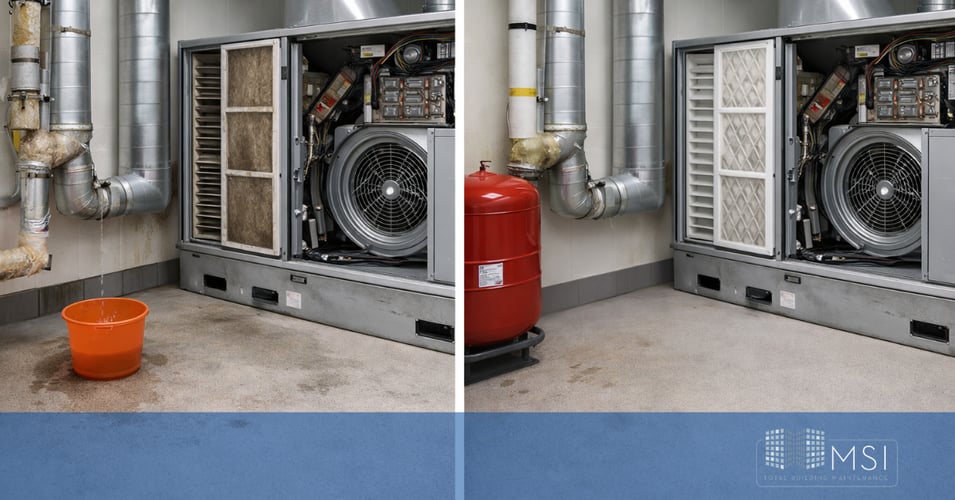
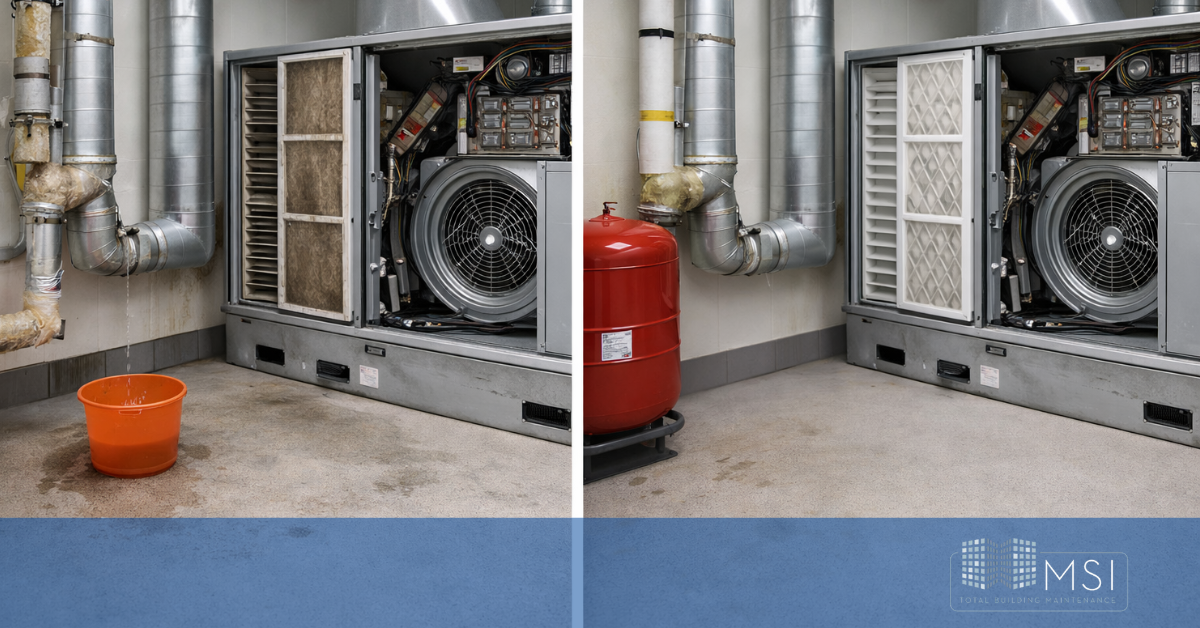
Last month, the HVAC repair was done professionally—clean work, proper documentation, system running perfectly.
This month, the plumbing fix was sloppy—leaks started again within two weeks, and you had to pay to have it redone.
Next month? Who knows what level of quality you'll get.
If this sounds familiar, you're experiencing one of the most insidious facility maintenance problems: inconsistent quality and lack of follow-through.
Unlike more obvious problems—can't find staff, projects abandoned, wrong person handling facilities—the quality consistency problem is harder to spot initially. The work gets done. Systems function (mostly). But over time, the impacts compound: repeated repairs, shortened equipment life, unpredictable costs, and a facility that never quite performs as well as it should.
At Managed Services, Inc. (MSI), we're often called in to clean up the mess left by years of inconsistent maintenance quality. We've seen what happens when there are no standards, no accountability, and no consistent approach to facility care.
In this article, we'll explore why facility maintenance quality varies so dramatically, what this inconsistency costs your business, and how to establish the reliable quality standards your building deserves.
Why Facility Maintenance Quality Is So Inconsistent
Let's start by understanding the root causes of this problem.
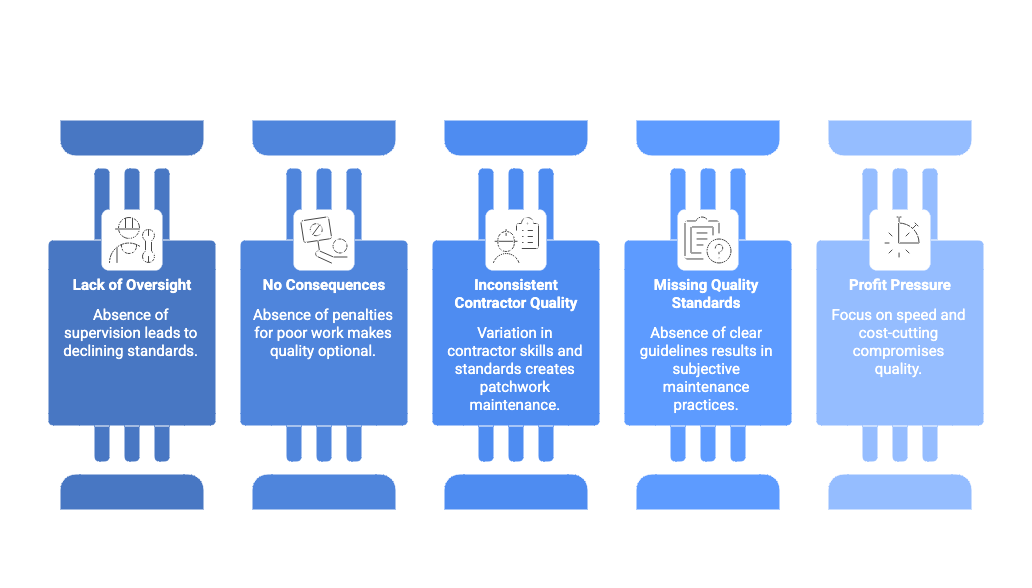
Lack of Oversight and Accountability
When there's no one monitoring the quality of maintenance work, standards inevitably slip. Think about it: If your in-house maintenance person has no direct supervision regarding their work quality, what motivates them to maintain high standards? If the contractor you hired will never be evaluated on quality—only on whether they show up and charge a reasonable price—why would they go above and beyond?
The accountability gap creates:
- Work that's "good enough" rather than done properly
- Shortcuts taken to save time or effort
- Necessary steps skipped because "no one will notice"
- Substandard materials are used because they're cheaper
- Minimal effort to ensure long-term reliability
Without oversight, the person doing the work becomes their own quality control—and human nature being what it is, standards tend to drift downward over time without external accountability.
No Consequences for Poor Work
This connects directly to the oversight issue: even when poor-quality work is identified, there are often no real consequences.
With in-house maintenance personnel: If your maintenance person is the only one you have, what are you going to do—fire them and go back to having no help at all? This creates a situation where even identified quality issues may not be addressed because the alternative seems worse.
With individual contractors: If a contractor does subpar work, you can choose not to hire them again. But:
- You've already paid for work that didn't solve the problem
- You still have to pay someone else to do it correctly
- The contractor faces no direct penalty except losing your future business
The lack of meaningful consequences means quality standards become optional rather than required.
Inconsistent Contractor Quality
When you hire different contractors for different projects—choosing based primarily on availability and price—quality varies wildly from one project to the next. The HVAC contractor might be excellent. The plumber might be mediocre. The electrician might be barely competent.
Quality Variation Factors:
- Different training levels
- Varying experience
- Different business philosophies
- Different material standards
- No consistent methodology
What you get is a patchwork of quality levels across your facility—some systems maintained excellently, others poorly, with no coherent standard.
Missing Quality Standards and Procedures
Without established specifications for how work should be done, everyone operates differently.
What does "properly maintained" even mean?
For your HVAC system, does it mean:
- Just keeping it running? Or
- Cleaning coils to manufacturer specifications? Or
- Optimizing efficiency settings? Or
- Full diagnostic testing? Or
- All of the above?
Without clear quality standards, "maintenance" becomes subjective. One contractor's version of maintenance might be basic visual inspection. Another's might include comprehensive testing and adjustment.
The problem compounds when you have multiple people working on your facility without shared standards. What one person considers complete, another might see as barely started.
Profit Pressure Drives Shortcuts
Here's an uncomfortable reality: when contractors or maintenance workers are pressed for time or focused primarily on speed, quality suffers.
The economics work against quality:
- Doing work correctly takes longer
- Using proper materials costs more
- Thorough testing and verification add time
- Proper documentation requires effort
When someone is trying to maximize the number of jobs completed or minimize time spent on each task, quality tends to be sacrificed. Not maliciously—just as a natural result of competing priorities.
This is especially true with:
- Contractors bidding jobs at rock-bottom prices (they have to cut corners somewhere to make it profitable)
- In-house maintenance personnel are managing too many responsibilities
- Anyone operating without quality oversight or accountability
The Real Cost of Inconsistent Quality
Quality inconsistency isn't just aesthetically unpleasing—it has concrete costs that add up dramatically over time.
Paying for the Same Repair Multiple Times
This is the most obvious cost: when work isn't done right the first time, you pay to have it done again (and sometimes a third time).
Typical scenario:
| Step 1: Problem arises (leaking pipe, HVAC not cooling properly, electrical issues) | Cost: Base |
| Step 2: Contractor comes out, makes repairs | Cost: $X |
| Step 3:Problem recurs within weeks or months | Risk: High |
| Step 4: Different contractor comes out to fix it properly | Cost: $Y |
| Total Financial Impact | $X + $Y for something that should have cost $Y once |
We've taken over maintenance for facilities where this pattern repeated across multiple systems—plumbing "fixed" repeatedly, HVAC "repaired" seasonally, electrical work "completed" but still not functioning correctly.
One client calculated they had paid three different contractors to fix the same HVAC issue over 18 months before calling us to actually solve it properly.
Shortened Equipment Life
Improper or inconsistent maintenance doesn't just fail to solve immediate problems—it actively shortens the life of your building systems and equipment.
Improper repairs: Fixing something the wrong way can stress other components, cause new problems, or create conditions that accelerate wear.
Skipped maintenance steps: When cleaning, lubrication, or adjustment steps are skipped, equipment runs less efficiently and wears out faster.
Wrong parts or materials: Using incorrect or substandard replacement parts can compromise system integrity and lead to premature failure.
Lack of proper calibration: Systems that aren't properly calibrated or adjusted run inefficiently and experience unnecessary wear.
An HVAC system that should last 15-20 years might need replacement in 10 years due to poor maintenance. A plumbing system that should be reliable for decades might fail repeatedly due to improper repairs.
The cost difference between maintaining equipment properly and replacing it prematurely can be tens or hundreds of thousands of dollars, depending on your facility's systems.
Unpredictable Costs and Budgeting Nightmares
When maintenance quality is inconsistent, you never know what's coming next.
This month, everything runs fine. Next month, three systems will fail. Two months later, a repair you paid for already needs to be redone. Budgeting for facility maintenance becomes nearly impossible when you can't predict what will break or what will need fixing multiple times.
This unpredictability creates several problems:
- Cash flow issues when unexpected repair costs hit
- Emergency spending at premium prices when something fails unexpectedly
- Difficulty planning capital expenditures because you don't know what will survive
- Stress and uncertainty for management trying to control costs
Consistent quality creates predictable costs. Inconsistent quality creates budgeting chaos.
Tenant and Employee Dissatisfaction
People notice when problems don't actually get solved.
The pattern becomes obvious:
- Issue reported (temperature problems, plumbing issues, etc.)
- Maintenance performed
- A brief period where things seem better
- Same problem returns
- Frustration builds with each repeat cycle
After experiencing this cycle a few times, tenants and employees lose confidence that facility issues will be resolved. They stop reporting problems promptly. They develop workarounds. They complain to each other (or worse, online in reviews).
The impact on morale, productivity, and tenant retention can be significant—but it's hard to directly measure, so it's often overlooked until you have vacancy problems or employee dissatisfaction surveys that mention facility issues.
Hidden Energy Costs
Systems that aren't properly maintained run less efficiently, consuming more energy while delivering poorer performance.
Common efficiency losses from poor maintenance:
- HVAC systems with dirty coils or improper refrigerant levels consume 10-30% more energy
- Lighting systems with degraded components waste electricity
- Plumbing systems with small leaks waste water continuously
- Building automation systems that aren't properly calibrated run inefficiently
These efficiency losses continue month after month, year after year, adding significantly to operating costs. Because the degradation is gradual, it's often not noticed—you don't see the efficiency baseline you should be achieving.
We've had clients whose energy costs dropped 15-20% simply by bringing their systems up to proper maintenance standards.
Real Examples: When Quality Consistency Matters
Let me share some situations we've encountered that illustrate the real cost of inconsistent quality.
The HVAC System That Became a Money Pit
We were called by a commercial building owner who was at his wit's end with HVAC problems.
Over two years, he had hired four different contractors to address cooling issues. Each time:
- • The contractor diagnosed the problem
- • Charged for repairs
- • The system seemed to work briefly
- • Problems returned within weeks or months
- • The owner called the next contractor on the list
By the time we got involved, he had spent over $15,000 on HVAC repairs—but the system still wasn't working properly.
When our technician did a comprehensive diagnostic, we found:
- Multiple previous repairs were done incorrectly
- Some "repairs" had actually created new problems
- Critical maintenance steps had been skipped for years
- The system was running at perhaps 60% efficiency
- Several components were damaged by the improper repairs
Our honest assessment: some of the previous repairs had caused more damage than the original problems. The system needed extensive corrective work to undo the damage from poor-quality repairs before we could even address the original issues.
Total cost for the owner:
If the work had been done right by a quality contractor the first time, the total cost would have been around $5,000-6,000.
The lack of quality consistency cost this owner nearly four times what proper repairs should have cost—plus two years of problems.
The Plumbing Repairs That Kept Coming Back
A professional office building had ongoing plumbing issues—slow drains, occasional backups, and water pressure problems.
They hired contractors on a job-by-job basis, usually whoever was available and gave a reasonable quote. Over 18 months:
- Five different plumbing contractors worked on various issues
- Some fixed things properly, others did minimal work
- Quality ranged from excellent to terrible
- Problems kept recurring or new ones emerged
When we came in to take over maintenance, we found:
- A mix of proper repairs and complete hack jobs
- Mismatched parts and materials throughout the system
- Some issues that had been "fixed" multiple times were still not resolved
- The lack of a consistent approach had created a plumbing system with no coherent maintenance history
We had to essentially audit the entire plumbing system to understand what had actually been done, identify what still needed fixing, and establish a proper maintenance baseline.
The inconsistent quality had created a situation where the building owner:
The Electrical Work That Created Safety Hazards
This is the most concerning example because poor-quality electrical work can be dangerous.
A retail facility had been using various electricians for repairs and projects—whoever was cheapest or available at the moment. They thought they were being financially prudent.
When we took over facility management and had our master electrician do a comprehensive assessment, we found:
Some of this work was so poor that we strongly recommended immediate corrective action before someone got hurt or the building failed an inspection.
The cost to bring everything up to code and safety standards was substantial—far more than if the work had been done properly initially.
The building owner had thought they were saving money by hiring the cheapest available electricians. Instead, they had:
- Created serious safety liabilities
- Spent money on repairs that had to be redone
- Put their building and occupants at risk
- Now faced a large bill to correct everything
The "savings" from cheap electrical work cost them more than triple what quality work would have cost—plus the liability risk.
How Professional Facility Maintenance Ensures Consistent Quality
So how do you break free from the cycle of inconsistent quality?
The answer is working with professional facility maintenance companies that have built-in quality systems and accountability structures.
Documented Quality Standards
Professional companies operate with established standards for every type of maintenance activity.
At MSI, we have documented procedures that specify:
- Exactly how each type of maintenance should be performed
- What materials and parts are acceptable
- Testing and verification requirements
- Documentation standards
- Quality checkpoints
This means every technician approaches each job with the same baseline standards. Work quality doesn't depend on an individual's mood or personal standards—it follows established company procedures.
Trained and Qualified Technicians
Professional facility maintenance companies invest in training their technicians to consistently high standards.
Our technicians receive:
This ongoing investment in quality means the person showing up to maintain your facility has current knowledge and proven skills—not just whatever level of competence they happened to arrive with.
Multiple Layers of Accountability
Unlike individual contractors or self-managed in-house staff, professional companies have management structures that ensure accountability.
At MSI, quality is monitored at multiple levels:
| Level | Quality Control Action |
|---|---|
| Technician level | Trained to perform work to established standards |
| Supervisor level | Reviews completed work and ensures standards are maintained |
| Quality control inspections | Random checks and scheduled reviews of work quality |
| Customer feedback | Systematically collected and acted upon |
| Management oversight | Tracking of quality metrics and addressing patterns |
When quality issues arise, they're caught quickly and corrected. More importantly, the system is designed to prevent quality issues in the first place.
Proper Tools and Equipment
Doing quality work requires proper tools. Professional companies invest in:
- Specialized diagnostic equipment
- Quality hand tools and power tools
- Safety equipment
- Testing and verification instruments
- Proper materials and components
Our technicians show up with what they need to do the job right—not improvising with whatever happens to be available.
Consistent Approach Across All Systems
When one company handles all your facility maintenance, you get consistency across all building systems.
- All systems are maintained to the same standards
- Consistent documentation and record-keeping
- Coherent maintenance history
- Ability to identify patterns across systems
- Coordinated approach to facility care
Compare this to the patchwork you get from multiple contractors with different standards, different approaches, and no coordination.
Warranty and Guarantee
Quality professional companies stand behind their work.
At MSI:
- ✔ We warrant our work
- ✔ If something isn't right, we make it right at no additional charge
- ✔ Our reputation depends on quality, so we have strong incentives to get it right the first time
This is very different from random contractors who might be difficult to reach for warranty work or who have no real stake in whether repairs last.
What Quality Consistency Looks Like in Practice
When you work with MSI for facility maintenance, here's what you can expect:
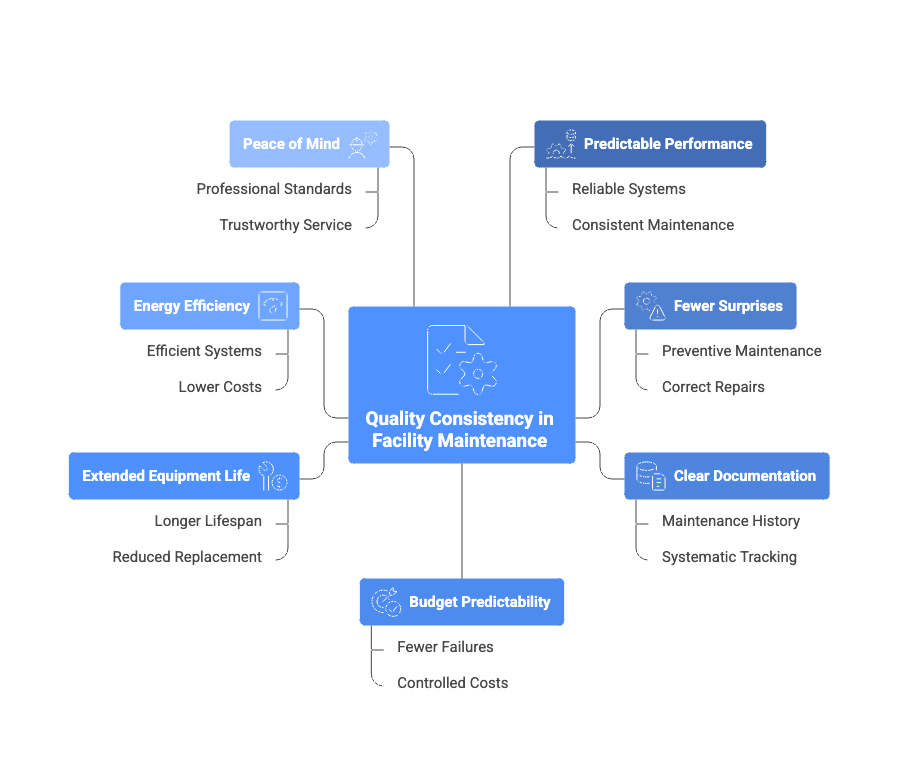
Predictable Performance
Systems work reliably because they're maintained properly and consistently.
Fewer Surprises
Preventive maintenance catches issues before they become emergencies, and when repairs are needed, they're done right the first time.
Clear Documentation
You always know what's been done, when, and by whom. Maintenance history is tracked systematically.
Budget Predictability
Consistent quality means fewer unexpected failures and emergency repairs. Costs become more predictable and controllable.
Extended Equipment Life
Proper maintenance means systems last as long as they should (or longer), reducing capital replacement costs.
Energy Efficiency
Properly maintained systems run efficiently, keeping operating costs down.
Peace of Mind
You can trust that facility maintenance is being handled to professional standards without having to verify quality yourself.
Making the Switch
If you're tired of the quality inconsistency lottery—never knowing if this month's repairs will hold or if you'll be paying to fix the same thing again next month—making the switch to professional facility maintenance is straightforward.
Comprehensive Assessment
We evaluate your facility to understand:
- Current condition of systems
- Maintenance history and quality of previous work
- Any immediate issues needing attention
- Long-term maintenance needs
Baseline Establishment
We bring all systems up to proper maintenance standards, correcting any previous poor-quality work.
Ongoing Professional Service
Regular maintenance is performed to consistent standards, with documentation, accountability, and quality verification.
Predictable Results
You enjoy reliable facility performance, predictable costs, and the peace of mind that comes from consistent quality.
The Bottom Line
Inconsistent facility maintenance quality is expensive, unpredictable, and completely preventable.
When you rely on random contractors or self-managed in-house staff without quality systems, you're gambling every time maintenance is performed. Sometimes you'll get lucky and get quality work. Other times, you'll pay for repairs that don't last and create new problems.
Professional facility maintenance eliminates that gamble by providing:
At MSI, we've built our business on consistent quality. We know that long-term client relationships depend on reliable results—not lucky breaks or hoping for the best.
Your facility deserves maintenance you can count on. Maintenance that actually solves problems instead of creating new ones. Maintenance is performed to professional standards every single time.
Ready for Consistent, Reliable Facility Maintenance Quality?
If you're tired of the quality lottery—tired of paying for repairs that don't last, tired of wondering if this month's maintenance will be done right—let's talk about how MSI can provide the consistent quality your facility deserves.
Contact Managed Services, Inc. today to schedule a free facility assessment and learn how professional maintenance services can deliver the reliable quality you've been missing.
We serve businesses throughout the Twin Cities seven-county metro area with comprehensive facility maintenance services, including:
- HVAC mechanical services
- Electrical repairs and installations
- Plumbing services
- General maintenance and repairs
- Preventive maintenance programs
- Quality assurance and documentation
Let us show you what consistent, professional quality looks like—so you can stop playing the maintenance lottery and start enjoying reliable facility performance.